Kimi K3.1 Pro Explained: What Moonshot Claims, What Independent Tests Show and What the Promised Open Weights Mean
Kimi K3.1 Pro launched in Moonshot's API on 23 October 2026. See what is documented, what is vendor-claimed, and what to check before relying on it.
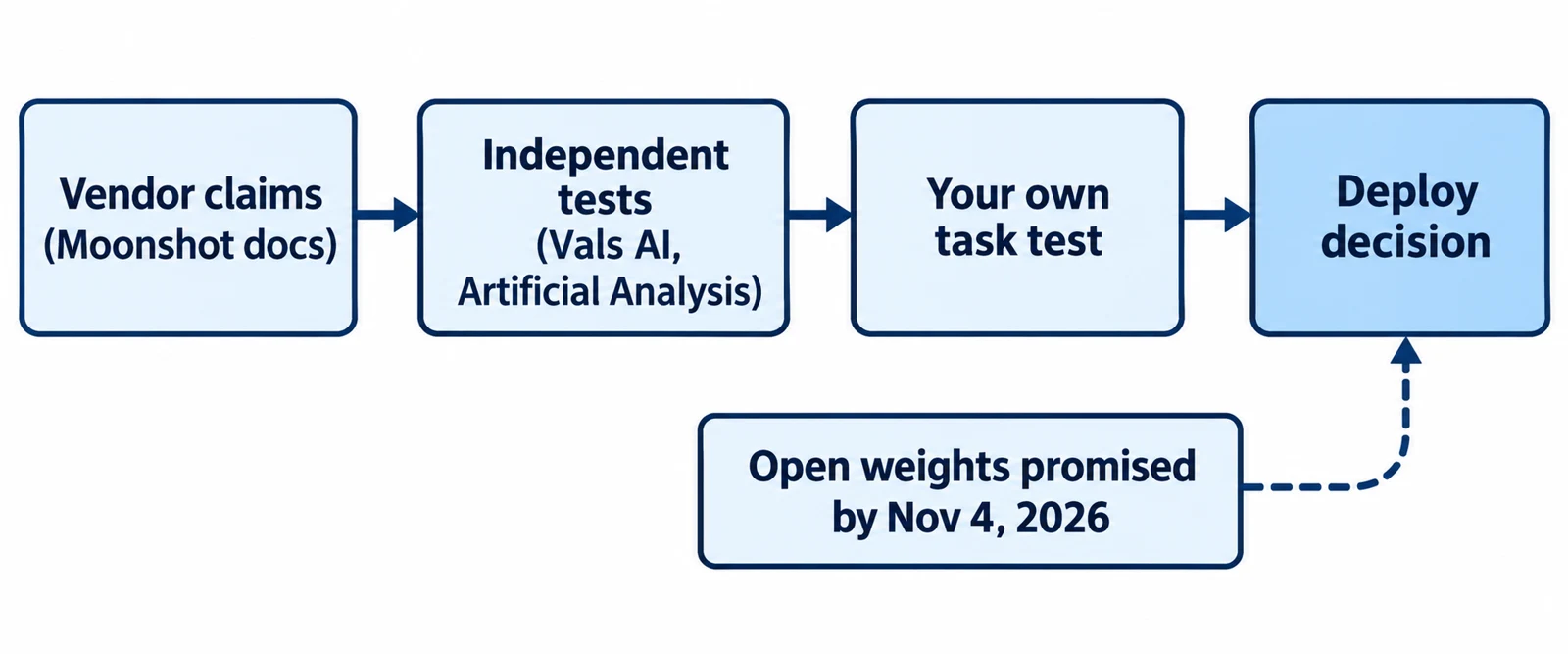
On 23 October 2026, Moonshot AI released Kimi K3.1 Pro through its hosted API. Moonshot calls it an upgraded version of its earlier Kimi K3 model. It also says the model's weights, the downloadable files that make up a model, will follow by 4 November 2026.
This article separates what is documented from what is only claimed. It explains how the model is built, what outside testers measured, and what to check before you use it. As of 2 November 2026, the weights were still a promise, not a download.
Article index
- What was released, and when
- How the model is built, in plain English
- Vendor claims versus independent evidence
- Deployment, cost, security and privacy
- A worked example
- Common mistakes
- Recap
- Research Sources
What was released, and when
Moonshot's own quick-start page describes Kimi K3.1 Pro as a "post-trained Kimi K3 variant" with a 1-million-token context window. The context window is how much text the model can consider at once. The model ID is kimi-k3.1-pro, and a faster kimi-k3.1-pro-highspeed variant is listed at 2 to 3 times the speed. Source: Moonshot's K3.1 Pro quick-start.
The release date is 23 October 2026. Both the Artificial Analysis model page and the Vals AI model page give that date, and Simon Willison's post is dated the same day. Vals AI published its evaluation update on 24 October. Those are reporting dates, not release dates.
The weights are the open question. The quick-start says full weights will be released by 4 November, and Willison's post repeats the promise. When I opened Moonshot's Hugging Face organization page, it listed Kimi-K3 but no K3.1 entry. So "open-weight" describes an intention today. It does not describe something you can download.
How the model is built, in plain English
Moonshot has not published a K3.1 model card that I could open. The best documented base is the Kimi K3 model card. K3.1 Pro is described as a post-trained K3, so the card is a useful guide. Treat K3 figures as K3 figures, not as confirmed K3.1 specifications.
Mixture of experts
The K3 card describes a mixture-of-experts (MoE) design. An MoE model contains many small specialist sub-networks called experts. For each token, a small piece of text, a router picks only a few experts to run. The card lists 2.8 trillion total parameters but only 104 billion active for each token, with 896 experts per layer and 16 selected per token.
Attention and memory
Attention is the step where a model weighs which earlier tokens matter. The card says most attention layers use Kimi Delta Attention (69 layers), with 24 Gated MLA layers. The card does not explain the trade-offs in detail. Mixing attention types is commonly done to make long contexts cheaper, but that is general background, not a claim from the card.
Compressed weights
The card says K3 uses MXFP4 weights, a 4-bit number format, with quantization-aware training. That means the model was trained knowing its numbers would be squeezed. As my own rough arithmetic, 2.8 trillion parameters at 4 bits is about 1.4 terabytes for weights alone. That excludes working memory. The card does not state GPU counts, so plan for a large multi-GPU server.
Vendor claims versus independent evidence
What Moonshot claims
The quick-start calls K3.1 Pro the "most capable 3T-class open-weight model to date." It says the model matches or approaches the strongest proprietary models. It also reports a claim-level hallucination rate falling from 23.35% for K3 to 6.85%. A claim-level rate counts individual factual statements that are wrong, not whole answers.
Moonshot's own caveat matters here. The page says the rates come from a stress test and do not reflect typical daily use. Several other score lines, including the Terminal-Bench 4.0 entry, were placeholders such as "[xx.x%]" when I opened the page. These are vendor claims, and some are unfinished.
What outside testers measured
Vals AI ran the model on 16 benchmarks with temperature 1, top-p 0.95 and maximum reasoning effort. It reports a Vals Index of 62.52% (plus or minus 1.14), up from 52.96% for Kimi K3. Vals says that is the top score among open-weight models, ahead of DeepSeek V4.1 Flash 1017 at 61.26%. On Terminal-Bench 4.0, a test of command-line work, it scored 63.64%, within about two points of Claude Opus 5.5 at 65.15%. Source: Vals AI.
The same page shows weaker spots. The model scored 56.01% on the Vals Finance Index and 67.04% on the Legal Index, with mid-table ranks of 20 of 35 and 25 of 33. Vals also says it trails K3 on Legal Research Bench, Tax Agent Bench and HLAB-Vals-1.1. This is mixed evidence, which is normal. Also note the page is internally inconsistent: it shows rank 9 of 32 on the page but 8 of 27 in the update, and two different output-token limits.
Artificial Analysis gives a different picture. Willison reported on 23 October that it scored the model 55. The Artificial Analysis page I opened shows 46 on its Intelligence Index v5.0, ranked 22 of 59. It also lists speed of about 30.8 output tokens per second, ranked 193 of 195, and says the model is somewhat verbose. I could not find the reason for the 55 versus 46 gap, so always record the index version and date. Source: Artificial Analysis.
Informal checks
Willison also drew a pelican on a bicycle at three reasoning settings. He called the max result mostly good but noted both legs ended up on the same side of the frame. That is one prompt and one person's view, not a benchmark.
Deployment, cost, security and privacy
API behavior that affects design
The quick-start documents several behaviors. Thinking mode is always on and cannot be switched off. reasoning_effort accepts low, high or max, and the default is max. Temperature and top-p are fixed. In tool-calling conversations you must send back the complete assistant message, not only its text. The page also says web search is being updated and is not recommended for production in the near term.
Price and speed
Willison lists $2 per million input tokens and $10 per million output tokens, and says the Highspeed tier costs twice as much. Artificial Analysis lists the same prices and a 90% discount for cache hits, meaning repeated input that the service has already stored. Its page rates cost per task at $3.68 and says the model is somewhat verbose. Because reasoning is always on, test real output length before you budget. I did not verify whether reasoning tokens are billed as output, so check Moonshot's pricing page.
Security and privacy
Using the hosted API means your prompts and files travel to Moonshot's servers. I did not review Moonshot's data-retention or training policies, so confirm them before sending customer, legal, health or source-code data. Self-hosting could change that, but only after weights ship and you have read the license. The K3 card uses a custom "Kimi K3 License." I have not seen a K3.1 license.
If you give the model tools, apply normal agent controls: least-privilege access, human approval for risky actions, and logging. A strong benchmark score does not make an agent safe to connect to production systems.
A worked example
This is an illustrative scenario, not a test I ran. A small finance team wants to know whether Kimi K3.1 Pro can summarize supplier contracts. The prices below come from the sources above. The token counts are invented for the exercise.
- Define the task. Input: 40 sample contracts, with identifying details removed. The team writes a checklist of facts each summary must contain. Result: a pass or fail test. This matters because public benchmarks do not cover your documents.
- Read the evidence. Input: the Vals and Artificial Analysis pages. The team sees mid-table finance and legal ranks, and notes the vendor's own caveats. Result: a hypothesis, not a decision. This matters because vendor claims show where Moonshot aimed, not how it will do on your files.
- Estimate cost. Assume one task uses 50,000 input tokens and 8,000 output tokens. Input costs 0.05 million times $2, or $0.10. Output costs 0.008 million times $10, or $0.08. The total is $0.18 per task before extra reasoning output. This matters because verbose output can raise the real bill.
- Run the pilot. Input: the 40 contracts at
reasoning_effortlow, thenmax. The team records accuracy against the checklist, output length and wait time. Result: a small table. This matters because speed and cost may differ sharply between settings. - Check privacy. Input: Moonshot's data policy and the contracts' confidentiality terms. Result: a yes or no on the hosted API. If no, wait for weights and read the license. This matters because the pilot used sanitized data and production would not.
- Decide and recheck. If the pilot meets the checklist at acceptable cost, run a larger sample. If it fails, compare another model. After 4 November, check whether the weights and license actually appeared.
Common mistakes
- Calling it open-source today. The weights were promised, not shipped, when I checked. Wait for the files and license, and note that open-weight does not mean open-source.
- Treating K3 numbers as K3.1 numbers. The detailed architecture card is for K3. Say which model each figure belongs to.
- Quoting one leaderboard score. Scores of 55 and 46 for the same model show that index versions matter. Record version, date and settings.
- Reading the hallucination drop as a general error rate. Moonshot calls it a stress test. Measure errors on your own documents.
- Ignoring speed and verbosity. A cheap per-token price can still produce slow, long answers. Time a pilot run.
- Sending sensitive data without a policy check. Review retention and training terms first.
Recap
- Documented: Kimi K3.1 Pro reached Moonshot's API on 23 October 2026 with a 1-million-token context window and always-on reasoning.
- Promised, not delivered: the weights, due by 4 November 2026. Check the repository and license before planning self-hosting.
- Vendor claims, such as the hallucination drop, come with Moonshot's own caveats and some blank score fields.
- Independent results are mixed: strong overall and on terminal tasks per Vals AI, but mid-table on finance and legal, and slow per Artificial Analysis.
- Run a small test on your own tasks, and review the data policy before using real data.
Research Sources
- Moonshot Kimi K3.1 Pro quick-start (vendor documentation)
- Kimi K3 model card on Hugging Face (vendor documentation)
- Moonshot AI organization page on Hugging Face
- Simon Willison, 23 October 2026 (third-party commentary and informal tests)
- Vals AI evaluation of Kimi K3.1 Pro (independent benchmark)
- Artificial Analysis page for Kimi K3.1 Pro (independent benchmark)