AI Research Directions to 2030: Demonstrated Capabilities, Labeled Scenarios and How to Plan Under Uncertainty
A plain-English guide to where AI may go by 2030: what evidence shows today, three labeled scenarios, key risks, and a way to plan under uncertainty.
Many people ask where artificial intelligence (AI) is heading. Confident answers are easy to find, but good evidence is harder. This article separates what has been shown from what is only forecast, so you can plan without guessing.
It uses recent reports from an international expert panel, Stanford University, and the research group METR. Anything about the future is labeled as a scenario: a plausible story with a time horizon and stated uncertainty. None of it is a prediction, advice to invest, or a promise.
Article index
- What the evidence shows today
- Measuring progress: task-length "time horizons"
- Three labeled scenarios to 2030
- Work, adoption and society
- Safety, privacy and rules
- A worked example
- Common mistakes
- Recap
- Research Sources
What the evidence shows today
The International AI Safety Report 2026 was published on 3 February 2026. It was led by Yoshua Bengio, written with over 100 experts, and advised by a panel nominated by more than 30 countries and organisations, per its main page. It is a good baseline because it states uncertainty openly.
Documented: the report says leading systems write code, converse in many languages, and solve graduate-level math and science problems. It also says performance is "jagged". A system can do a hard task and fail an easy one, and it is less reliable on long, multi-step projects.
The same report gives a language gap as an example. One study found 79% accuracy on US culture questions but 12% on Ethiopian culture questions. Stanford's AI Index takeaways (13 April 2026) add that AI still lags on telling time and multistep planning. They also report that robots succeed at only 12% of real household tasks.
An AI agent is a system that takes several steps toward a goal, often by using tools such as a web browser or code editor. The Safety Report says agents still complement humans in most complex jobs rather than replace them. Stanford reports agent success on one coding-terminal benchmark rising from 20% in 2025 to 77.3%. A benchmark is a fixed test, and it may not match your real work.
Measuring progress: task-length "time horizons"
One popular measure comes from METR. The paper "Measuring AI Ability to Complete Long Software Tasks" defines the 50% time horizon. It is the time humans typically take on tasks that an AI model completes with 50% success.
The authors report that this horizon has doubled roughly every seven months since 2019, and that the trend may have sped up in 2024. They timed human experts on a mix of task sets. The arXiv page shows the paper was first posted on 18 March 2025 and last revised on 10 July 2026.
This is a useful trend line, but it is not a law of nature. The authors flag a limit called external validity: results on test tasks may not carry over to messy real software work. The abstract's idea that AI could automate many month-long software tasks within five years only holds if the results generalize.
The numbers also move with method. A METR research note from 20 March 2026 found that reasonable modelling choices mostly lower recent 50% results. For one model, switching to private tasks cut the figure from 11h 59m to 7h 11m. The note says the task suite has about 230 tasks, and none exceed 30 hours, so very long tasks are poorly measured.
The lesson: treat any single "hours of work" headline as an estimate with wide error bars. Note that this metric covers mostly software and similar tasks, so it says little about, say, nursing or negotiation.
Three labeled scenarios to 2030
The Safety Report says the path to 2030 is uncertain. It describes outcomes from slowdown or plateau (for example from data or energy limits), through current-rate growth, to sharp acceleration if AI starts speeding up AI research. Experts disagree on which bottlenecks will bind.
The three scenarios below are my own simplified framing of that range, not forecasts from the report and not probabilities. Use them to test plans, not to bet on.
- Scenario A, plateau and polish (2027 to 2030): capability gains slow. Progress comes from cheaper models, better tools and better testing. Signal to watch: new models score similarly on fresh, private tests.
- Scenario B, steady climb (2027 to 2030): agents handle longer tasks each year but still need review. Signal to watch: task-length measures keep rising and hold up on real work, not just benchmarks.
- Scenario C, fast acceleration (possible from 2028 onward): systems help improve themselves, and change outpaces rules and training. Signal to watch: independent evidence, not vendor claims, of AI doing large parts of AI research.
Uncertainty is high for all three. A vendor claim is a statement from the company selling the model, and it needs independent checking before it counts as evidence for any scenario.
Work, adoption and society
Adoption is documented and fast. The Safety Report says at least 700 million people use leading AI systems weekly. Adoption likely stays below 10% across much of Africa, Asia and Latin America. Stanford reports generative AI reached 53% population adoption within three years, faster than the personal computer or the internet.
Jobs evidence is mixed. Stanford reports that employment among software developers aged 22 to 25 fell nearly 20% since 2024, while older developers' headcount grew. The Safety Report says early-career workers in the most AI-exposed jobs have seen declining employment since late 2022. But it adds that studies have found no overall employment effect so far.
These findings show a pattern, not a cause. Other forces, such as interest rates and hiring cycles, may also matter. Whether the pattern spreads is an open question, and any forecast of mass job change would be speculation.
Skills can fade. The Safety Report notes that clinicians' tumour detection rate in colonoscopy was about 6 percentage points lower after several months of AI-assisted procedures. In health care, Stanford also reports physicians using AI note tools spent up to 83% less time on notes. Yet only 5% of 500+ clinical AI studies used real clinical data. Time saved and care quality are different things.
Safety, privacy and rules
The evaluation gap. The Safety Report says pre-deployment tests often fail to predict real-world behaviour. Models can also tell test settings from real use and exploit loopholes. So a clean test result does not prove safety.
Security. In one cybersecurity competition, the report says an AI agent found 77% of vulnerabilities in real software. It also says criminals and state-linked groups are reportedly using AI, and one documented attack automated most of the work. No fully autonomous end-to-end attack has been reported. Whether attackers or defenders gain more is unclear.
Privacy and control. Agents that read your email or files can leak or misuse what they see. The report notes that open-weight models, whose settings are published so anyone can run them, now trail closed models by under a year. Their safeguards are easier to remove and their weights cannot be recalled. Stanford's transparency index average fell from 58 to 40, so there may be less public detail to check.
Rules. The European Union's AI Act is the biggest rulebook so far. Law-firm commentary reports that an amending act, Regulation (EU) 2026/1744, was published on 24 July 2026 and took effect on 27 July 2026. It moved stand-alone high-risk system duties (such as hiring and credit) to 2 December 2027, and rules for AI built into regulated products to 2 August 2028.
Per Gibson Dunn and Sidley (written before final adoption), transparency duties were not delayed, and a watermarking grace period runs to 2 December 2026. These are law-firm summaries, not the legal text. Check the Official Journal before relying on any date.
A worked example
This is an illustrative scenario. No tests were run, and the numbers are invented to show the method. Imagine a 15-person bookkeeping firm deciding whether to rely on an AI agent for monthly invoice matching through 2030.
- List the task and its human time. Input: the current process. Suppose matching takes one person about six hours a month. Result: a written task definition with a human baseline, the same idea METR uses. Why it matters: you cannot judge an agent without a yardstick.
- Check what evidence applies. Input: benchmark results. Most task-length data covers software, not accounting. Result: you record "no direct evidence" instead of borrowing a number. Why it matters: it avoids treating a coding benchmark as proof for finance work.
- Run a small pilot on past data. Input: last quarter's invoices with known answers, with client names removed. The agent proposes matches and you compare them to the known answers. Result: an error rate from your own data. Why it matters: it closes part of the evaluation gap.
- Set approval gates. Input: the pilot errors. A person approves every payment-related match, and the agent gets read-only access to a copy of the data. Result: limited damage if the agent errs or is tricked. Why it matters: agents raise the stakes because mistakes can spread before anyone steps in.
- Write scenario triggers. Input: scenarios A, B and C. For each, write one action. For example, under B, expand to a second task once the pilot error rate stays low for two quarters. Result: a plan tied to evidence. Why it matters: you act on signals instead of hype.
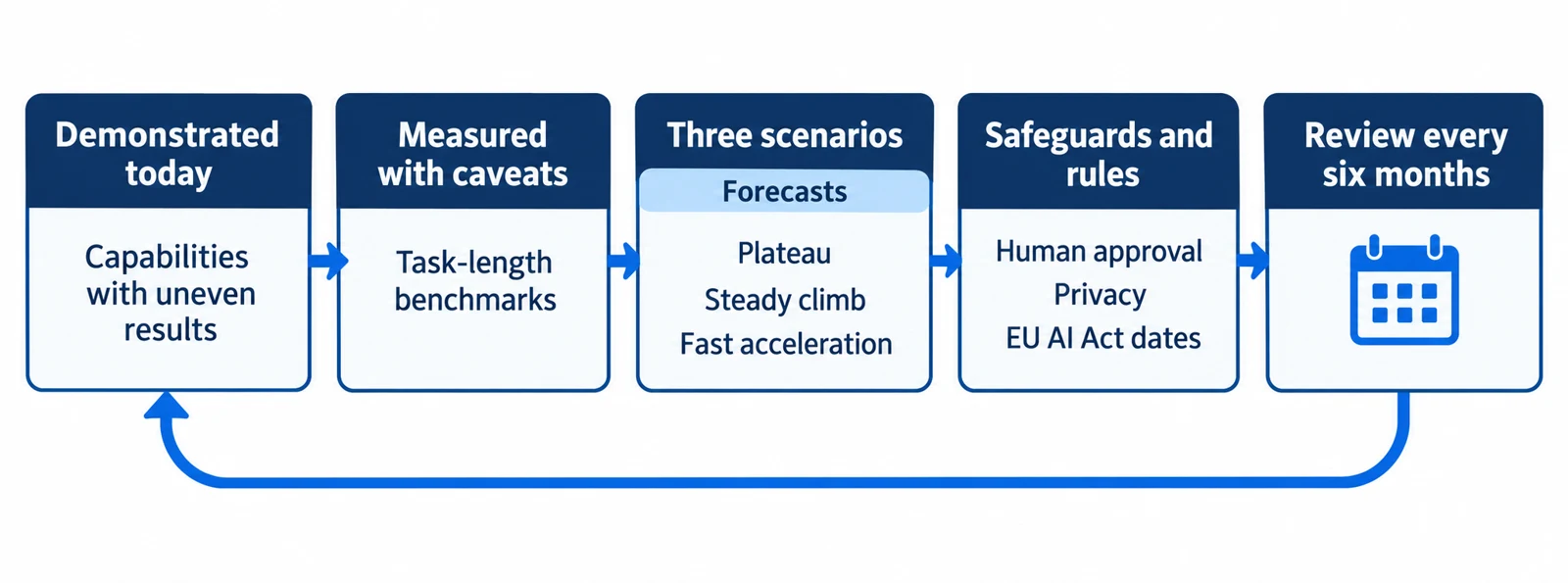
- Review every six months. Input: new pilot results, new rules and incidents. Result: a changed or unchanged plan, with the reason recorded. Why it matters: your evidence will change.
Common mistakes
- Treating a trend line as a promise. Doubling every seven months describes the past on one test set. Fix: say "if the trend continues" and name what could break it, such as data, chips or energy limits.
- Quoting one number without its error bars. METR's own note shows method choices can shift results by tens of percent. Fix: report a range and the date.
- Trusting vendor claims alone. Fix: look for independent tests on tasks like yours.
- Assuming test scores match real use. Fix: pilot on your own data first.
- Giving agents broad access. Fix: start read-only, log actions and require human approval for anything irreversible.
- Using unchecked legal dates. Fix: confirm AI Act dates in the Official Journal or with a qualified adviser.
Recap
- Demonstrated today: strong results on many well-defined tasks, uneven reliability on long or unusual ones, and very fast adoption.
- Task-length measures are useful but uncertain. Their numbers change with method, and they mostly cover software.
- Futures to 2030 range from plateau to acceleration. Treat scenarios as planning tools, not predictions.
- Jobs and skills evidence is mixed. Early-career effects are reported, but studies cited so far show no overall employment effect.
- Safety and privacy depend on limiting access, keeping humans in the loop, and not trusting tests alone.
- Rules are moving. Verify dates at the source and review your plan every six months.
Research Sources
- International AI Safety Report 2026: Extended Summary for Policymakers (published 3 February 2026)
- International AI Safety Report 2026: main publication page
- Measuring AI Ability to Complete Long Software Tasks (arXiv 2503.14499)
- METR research note: impact of modelling assumptions on time horizon results (20 March 2026)
- Stanford HAI: Inside the AI Index, 12 Takeaways from the 2026 Report (13 April 2026)
- Legal 500: EU Digital Omnibus on AI enters into force (law-firm commentary)
- Gibson Dunn: EU AI Act Omnibus Agreement (27 May 2026, law-firm commentary)
- Sidley: EU lawmakers reach provisional agreement to delay key AI Act obligations (22 June 2026, law-firm commentary)