Can a Language Model Leak Its Training Data? Memorization, Membership Inference and Practical Privacy Controls
How language models leak training data, what membership inference means, and practical controls to reduce privacy risk before you fine-tune or deploy.
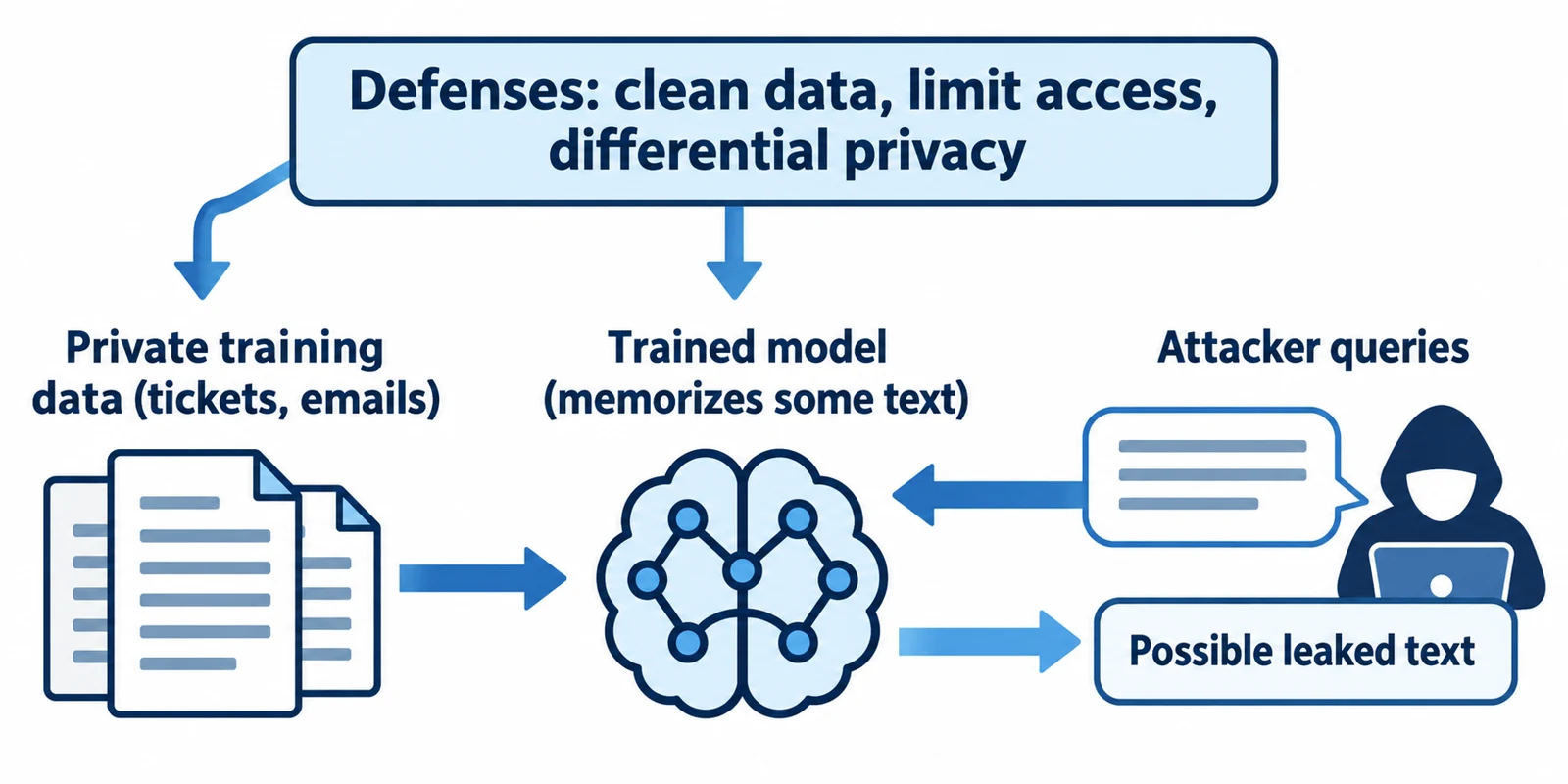
A language model learns by reading huge amounts of text. A natural worry follows: can someone ask the model questions and get private text back? Research says yes, in some cases. This article explains how that happens, what the main attacks are called, and which controls help you reduce the risk.
It is written for people who build or buy AI features and are new to AI security. We separate documented research findings from our own explanation, and we use one made-up example (clearly labeled) to show the ideas in practice.
Article index
- What memorization means and why it matters
- Training data extraction attacks
- Membership inference: was this record in the training set?
- A worked example
- Defensive controls you can apply
- What differential privacy offers, and what it does not
- Common mistakes
- Recap
- Research Sources
What memorization means and why it matters
Memorization means a model has stored some of its training text closely enough to repeat it. A model that only learned general patterns would write new sentences. A model that memorized a passage can reproduce it word for word.
This matters because training data often contains things people never meant to publish. The OWASP project, a well-known security community, lists sensitive information disclosure as LLM02:2025 in its Top 10 for LLM applications. It names personal data, financial and health records, confidential business data, credentials, legal documents and proprietary model details as things that can leak through model output.
There are two separate places where leaks happen. One is the model itself, which may have memorized training text. The other is the application around the model, such as a system prompt, a connected database or a chat log. This article focuses mostly on the first, but the controls section covers both.
Training data extraction attacks
A training data extraction attack is a series of queries designed to make a model print text it was trained on. The attacker does not need to break into any server. They only need to send prompts and read the answers.
The classic study is Extracting Training Data from Large Language Models, first posted in December 2020. According to its abstract, the authors attacked GPT-2 and recovered hundreds of verbatim text sequences. These included names, phone numbers, email addresses, chat conversations, code and 128-bit UUIDs (long random identifiers). The attack worked even on sequences that appeared in only one training document, and larger models were more vulnerable than smaller ones.
A later paper, Scalable Extraction of Training Data from (Production) Language Models (November 2023), widened the picture. The authors report extracting gigabytes of training data from open models such as Pythia and GPT-Neo. They also tested semi-open models (LLaMA and Falcon) and the closed model ChatGPT.
The ChatGPT result is the most useful for practitioners. According to the authors, existing techniques were enough for unaligned models. Alignment is extra training that makes a model behave like a helpful, safe chatbot. To get past it, they built a "divergence attack" that pushes the model away from chatbot behavior, and they report this made it emit training data at a rate about 150 times higher than normal. Their conclusion, in their words, is that "current alignment techniques do not eliminate memorization."
Both results are research findings from the authors. They show what is possible under the tested conditions. They do not tell you how often any particular product leaks, and vendors may have changed their systems since the papers were written.
Membership inference: was this record in the training set?
Sometimes an attacker does not need the text back. They only want to learn whether a specific record was used for training. This is called a membership inference attack.
The foundational paper is Membership Inference Attacks against Machine Learning Models, posted in 2016 and published at the IEEE Symposium on Security and Privacy in 2017. The attacker has black-box access, meaning they can send inputs and see outputs but cannot look inside. They train their own inference model to spot differences between how the target behaves on training records and on unseen records. The authors tested classifiers from commercial machine-learning-as-a-service providers, including Google and Amazon, and found them vulnerable in their experiments.
Why does this matter? The authors point to a hospital discharge dataset, where simply being in the data reveals something private. If a model was trained only on patients with a certain condition, confirming that a person is in the training set says something about their health. My explanation: the same logic applies to any narrow dataset, such as a list of people who complained, applied or were flagged.
The standards body NIST (the US National Institute of Standards and Technology) places this kind of risk in a wider map. Its report Adversarial Machine Learning: A Taxonomy and Terminology of Attacks and Mitigations (NIST AI 100-2 E2025), finalized in March 2025, organizes attacks by life-cycle stage and by what the attacker wants, knows and can do. I opened the summary page only, so I rely on it here just for that framing, not for details of specific attacks.
A worked example
Illustrative scenario only; no test was run. Imagine a small company, "Northwind Support," that fine-tunes a language model on past customer support tickets to draft replies. Some tickets contain customer names, phone numbers and order details. Here is how the risk and the fix could unfold.
- Collect the data. Input: an export of old tickets. What happens: the team reviews a sample and finds phone numbers and email addresses in the free-text fields. Result: they know the data is not clean. Why it matters: anything in the training set could later be memorized.
- Scrub before training. Input: the raw tickets. What happens: the team masks emails, phone numbers and account numbers with pattern matching, then spot-checks the output by hand. Result: a cleaned set where those fields read like "[EMAIL]". Why it matters: OWASP lists sanitization and redaction before training as a first-line control, and data the model never sees cannot be memorized.
- Test for leakage. Input: the fine-tuned model and a set of probe prompts, such as the start of a ticket template. What happens: the team checks whether the model completes them with text that matches real training tickets. Result: either no match, or a list of leaked fragments. Why it matters: the extraction research shows that verbatim recovery can happen, so you should look for it before an attacker does.
- Limit who can query. Input: the deployment plan. What happens: the model is placed behind login, with rate limits and logging, and is given no access to the full ticket database. Result: fewer people can run the thousands of queries an extraction attack may need. Why it matters: the attacks above rely on repeated querying (my reading of the papers), and OWASP recommends least-privilege access.
- Monitor and respond. Input: production logs. What happens: the team flags unusual patterns, such as very long repetitive prompts, and reviews them. Result: a path to detect and block abuse. Why it matters: the divergence attack in the production-model study worked by pushing a model off its normal behavior, so odd prompts are worth watching.
If step 3 finds a leak, the next check is to trace the leaked text to its source ticket, improve the scrubbing rules, and retrain. Patching the output alone does not remove what the model has stored.
Defensive controls you can apply
No single control makes a model safe. Layers work better. The following list combines OWASP's documented mitigations with my own explanation.
- Clean the data first. OWASP advises scrubbing or masking sensitive content before training and validating inputs strictly. The less private text goes in, the less can come out.
- Apply least privilege. Give the model and its users only the data and tools they need. OWASP also recommends restricting access to external data sources.
- Do not rely on the system prompt. OWASP notes that prompt-level restrictions on data types can be bypassed by prompt injection or other techniques. Treat them as a speed bump, not a lock.
- Be clear with users. OWASP suggests telling users not to submit sensitive data, publishing retention and deletion policies, and offering an opt-out from training.
- Consider privacy-preserving training. OWASP lists federated learning (training on decentralized data) and differential privacy (adding noise). The next section explains the second.
- Test, log and watch. Run extraction-style probes before launch, and review logs afterward. This follows from the research above rather than from a single standard.
What differential privacy offers, and what it does not
Differential privacy is a mathematical way to limit what a result reveals about any one person. NIST describes it in Guidelines for Evaluating Differential Privacy Guarantees (SP 800-226), published in March 2025, as a framework for measuring the privacy loss a person faces when their data is included in a dataset. In simple terms, the system adds carefully measured randomness so the output looks nearly the same whether or not your record was included.
That idea speaks directly to membership inference, which asks whether a record was included. It is a strong tool when applied well. NIST's guidance, however, stresses that putting the theory into practice has pitfalls, which it calls "privacy hazards." It also offers a "differential privacy pyramid" of factors to weigh when evaluating a system.
My practical reading: ask any vendor who claims "differentially private" training what guarantee they measure and how they checked it. A label alone is not evidence. Also expect trade-offs. Adding noise can reduce model quality, so you must test accuracy and privacy together.
Common mistakes
- Assuming a chat model forgot its training data. The 2023 study found alignment does not eliminate memorization. Correction: test the model itself, not just its polite behavior.
- Believing rare data is safe. The 2020 study recovered sequences that appeared in just one document. Correction: scrub personal details even if each one seems unique.
- Treating the system prompt as a security boundary. OWASP notes such rules can be bypassed. Correction: enforce access limits in code and data permissions.
- Ignoring membership leaks. Teams focus on text output and forget that confirming someone is in a dataset can be harmful. Correction: judge sensitivity of the dataset's purpose, not only its fields.
- Trusting a privacy label. Correction: ask for the measured guarantee, as NIST's hazards guidance suggests.
- Fixing leaks only at the output. Filtering a reply does not remove stored data. Correction: fix the data and retrain when a leak is confirmed.
Recap
- Language models can memorize training text, and researchers have extracted names, phone numbers, emails and code from a real model through queries alone.
- Alignment is not a fix: the 2023 study reports that it did not eliminate memorization in ChatGPT.
- Membership inference asks whether a record was in the training set, and early research showed commercial services could be vulnerable.
- Clean data before training, limit access, test for leakage and monitor use, following OWASP's guidance.
- Differential privacy gives a measurable guarantee, but NIST warns of practical hazards, so verify claims.
Research Sources
- Extracting Training Data from Large Language Models (arXiv, December 2020; revised June 2021)
- Scalable Extraction of Training Data from (Production) Language Models (arXiv, November 2023)
- Membership Inference Attacks against Machine Learning Models (arXiv, October 2016; IEEE S&P 2017)
- OWASP Top 10 for LLM Applications: LLM02:2025 Sensitive Information Disclosure
- NIST SP 800-226: Guidelines for Evaluating Differential Privacy Guarantees (March 2025)
- NIST AI 100-2 E2025: Adversarial Machine Learning taxonomy (March 2025)