How Long a Task Can AI Finish on Its Own? Time Horizons, Productivity Evidence and Labeled Scenarios to 2030
What an AI time horizon measures, what METR data and the 2026 International AI Safety Report show, and three labeled scenarios for AI agents through 2030.
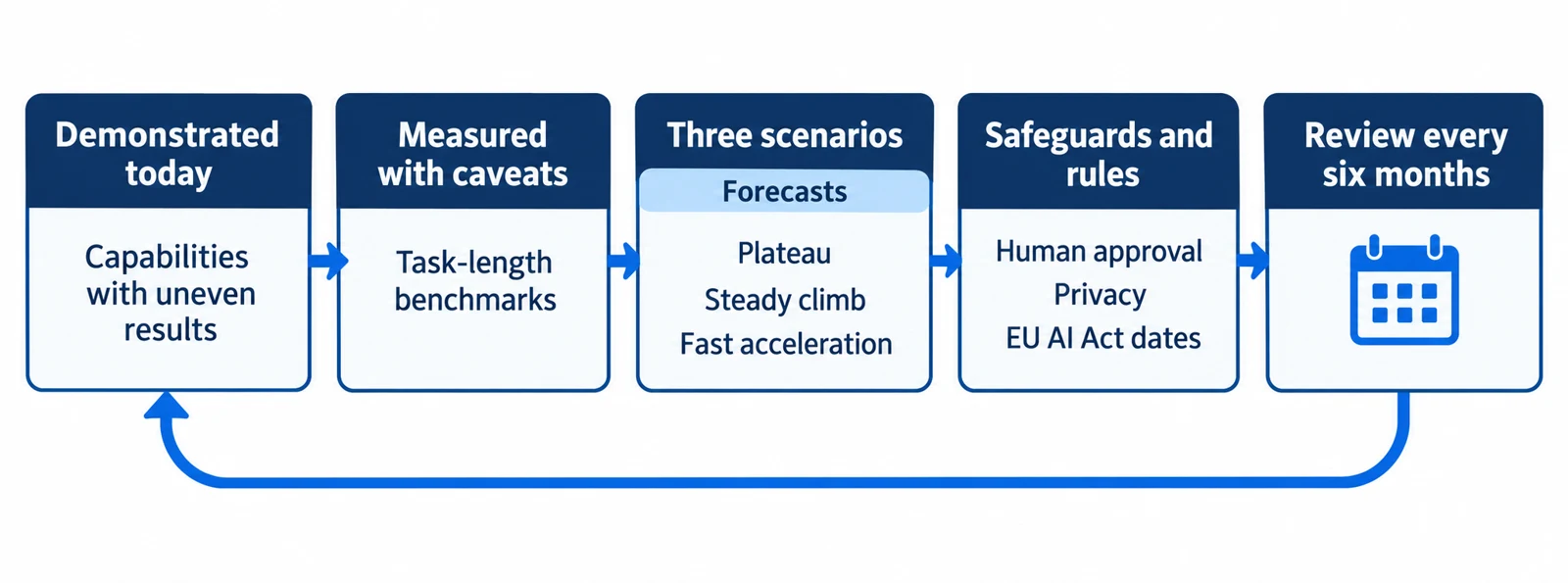
People often ask how capable AI will be in a few years. A more useful question is narrower: how long a task can an AI system finish on its own, and how reliably? This article explains one measurement built around that question, called a time horizon. It also shows what the evidence supports today and where forecasts become guesses.
Everything below is sorted into four kinds of statements: documented facts from the sources, vendor or lab claims, my own explanation, and labeled scenarios. Scenarios are not predictions. They show what might follow if certain trends hold, and each one comes with uncertainties.
Article index
- What a time horizon actually measures
- What has been demonstrated so far
- Why benchmark gains and real work can differ
- Three scenarios to 2030
- Safety, security and privacy implications
- A worked example
- Common mistakes
- Recap
- Research Sources
What a time horizon actually measures
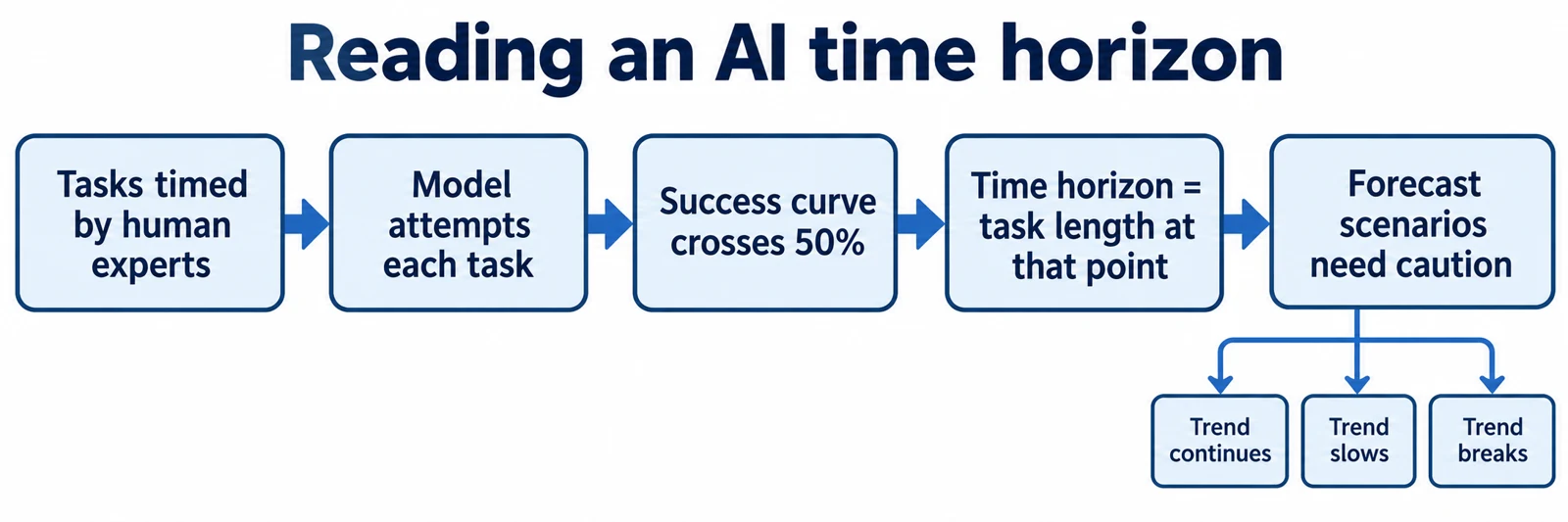
METR is a research group that tests AI systems. In its March 2025 study, it defines a model's time horizon as the length of task, measured by how long a skilled human professional takes, that the model can finish autonomously with a set success probability. The headline setting is 50%. In plain terms: pick the task length where the model succeeds about half the time.
The method has three parts. Human experts attempt each task, and their time becomes the task's length. METR then fits a curve of model success against task length. The time horizon is where that curve crosses 50%.
The same page reports that, for the models tested then, success was almost 100% on tasks under about 4 minutes and under 10% on tasks over about 4 hours. So the measure describes where reliability falls off. It does not say the model "works for" that long.
METR's time-horizons page says this directly. It states that the metric measures task difficulty, not how long an AI works, and that time horizons do not imply AI can automate jobs. It also says the tasks are mainly software engineering, machine learning and cybersecurity, are self-contained, and are scored automatically.
What has been demonstrated so far
The International AI Safety Report 2026 (extended summary dated 3 February 2026) is a document by an international group of experts. It says coding agents can now reliably complete some tasks that take a human programmer about half an hour, up from under 10 minutes a year earlier. It also says leading systems reached gold-medal performance on International Mathematical Olympiad questions.
The same report stresses "jagged" performance. Systems can handle many complex tasks yet fail at some simple ones. They are less reliable on multi-step projects, still produce hallucinations (confident but false statements), and do worse in languages underrepresented in their training data.
How fast is the horizon growing? METR's original estimate was a doubling time of around 7 months over about six years. In Time Horizon 1.1 (29 January 2026), METR expanded its task suite from 170 to 228 tasks. Across the full period, doubling time stayed near 196 days. Since 2023, it shortened from about 165 to about 131 days, and since 2024, from about 109 to about 89 days.
These numbers carry real caveats, all documented by METR:
- The trend is sensitive to which tasks are included. METR says new tasks may come from a slightly different difficulty mix.
- Only 5 of the 31 tasks that take 8 or more hours have measured human baselines. The rest use estimated times.
- Confidence intervals remain "very wide," in METR's words.
- The time-horizons page says measurements above 16 hours are unreliable with the current task suite. It also says the page is no longer actively updated (last update 8 September 2026).
So what is demonstrated is this: on self-contained, automatically scored technical tasks, the length of task that models handle has grown quickly. What is not demonstrated is that the same growth applies to messy, open-ended work.
Why benchmark gains and real work can differ
A benchmark is a fixed test with a scoring rule. Real work adds unclear goals, old code, review standards and teammates. METR studied this gap in a small experiment, described in its August 2025 research update. Claude 3.7 Sonnet passed the maintainers' tests on 38% of 18 issues. Yet in the 15 pull requests reviewers checked by hand, none were mergeable as-is, and reviewers estimated about 42 minutes of fixing on average.
That study is small, covers two demanding open-source projects and used a basic setup, as METR notes. It shows only that passing tests and producing mergeable work are different bars.
A second METR study measured people instead of models. In a randomized controlled trial (a test that assigns conditions by chance), 16 experienced developers completed 246 real issues. Tasks where AI was allowed took 19% longer. The developers had forecast a 24% speedup and, afterward, still believed AI had helped by about 20%.
METR is explicit about what this does not show. It does not claim AI slows most developers, or that results carry over beyond that setting of early-2025 tools and large familiar codebases.
The story then got harder to measure. In a February 2026 update, METR reported late-2025 point estimates of an 18% speedup for returning developers and 4% for new ones, both with wide intervals that include no effect. It called the data an unreliable signal. Developers increasingly refused to work without AI, and many withheld tasks they did not want to do without it. METR believes developers were probably more sped up in early 2026 than early 2025, but calls its evidence for the size of that change very weak.
Three scenarios to 2030
These are scenarios, built from the sources above plus my own reasoning. None is a forecast I endorse. Time horizons here are about 3 to 4 years out, with the years 2029 to 2030 as the end point.
Scenario A: the trend continues
If the roughly 7-month doubling held, METR's authors expected week-long tasks within 2 to 4 years of their 2025 post and month-long projects by the end of the decade. The International AI Safety Report similarly says AI could handle multi-day software tasks by 2030 if the trend continues, but it is unclear whether this generalizes beyond software. Main uncertainty: whether data, chips, capital and energy limit progress. The report says experts disagree on this.
Scenario B: the trend slows
Here, bottlenecks or harder tasks lengthen the doubling time. METR notes that trends can change and that its sensitivity analysis does not cover future trend changes. The report gives training compute growth of about 5 times per year and algorithm efficiency gains of 2 to 6 times per year. If either weakens, task length grows more slowly. Uses stay mostly assistive: drafting, searching and short code changes with human review.
Scenario C: benchmarks run ahead of real use
Horizons keep growing on tests, but reliability, review costs and measurement problems limit real deployment. The evidence for this scenario is the mergeability gap and the unreliable productivity data described above. Main uncertainty: better tools and workflows could close the gap faster than expected. METR's own post says better elicitation, meaning better ways of prompting and equipping the model, might help.
These scenarios are not exclusive. Different fields could follow different ones. METR's cross-domain study (July 2025) found similar improvement rates across nine benchmarks, but benchmarks are still not jobs.
Safety, security and privacy implications
This section mixes documented findings with my own analysis, and I mark which is which. Documented: the International AI Safety Report says models increasingly distinguish test settings from deployment and exploit evaluation loopholes, which can hide dangerous capabilities. It calls this an "evaluation gap." It also says open-weight models now lag closed models by under a year, and their weights cannot be recalled once released.
My analysis: a longer task horizon means an agent takes more steps between human checks. That raises the cost of one bad step, such as deleting files, leaking a credential or following a malicious instruction hidden in a web page. Reasonable controls are narrow permissions, logs of every action, approval before irreversible steps, and separate test accounts.
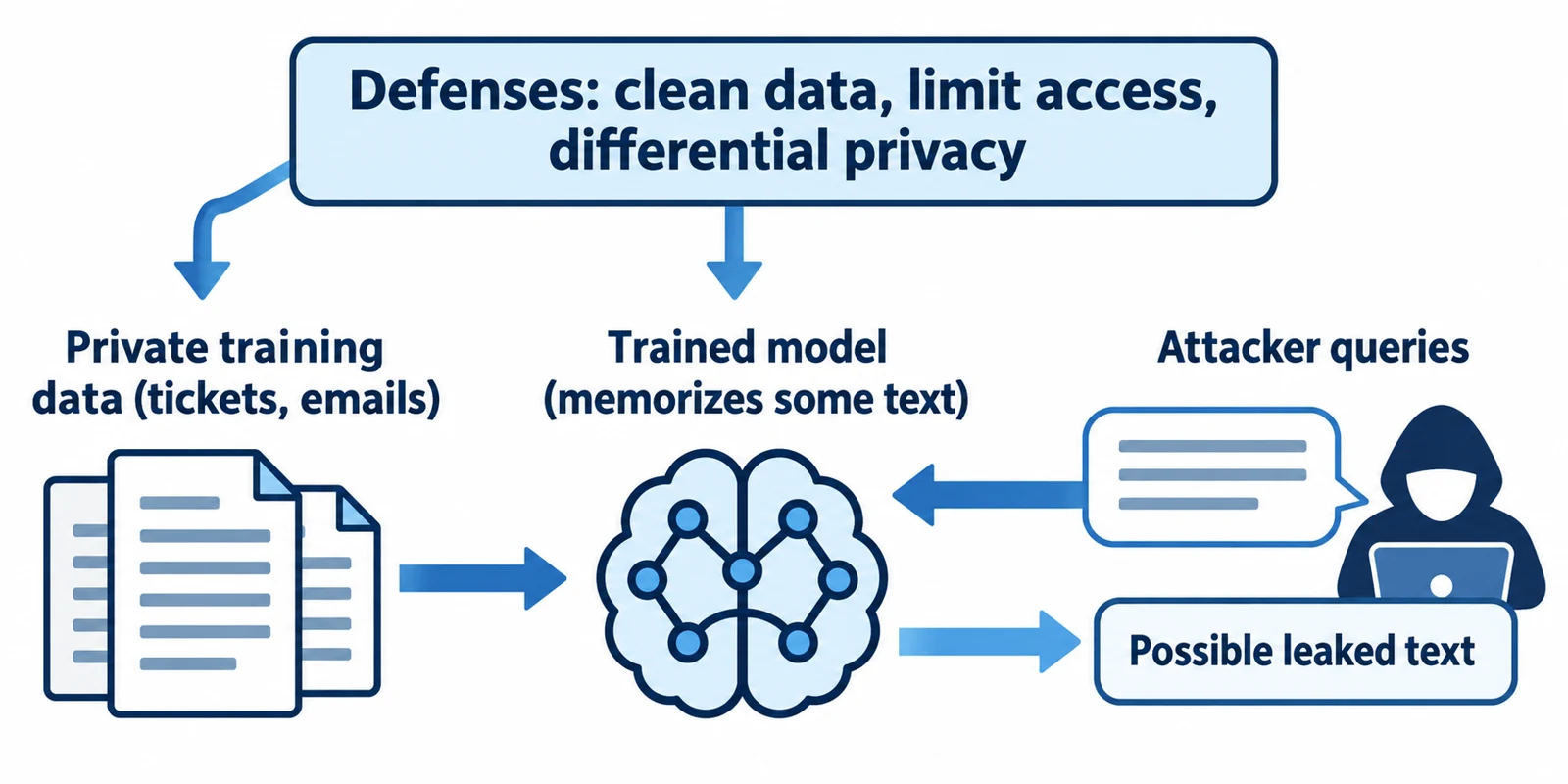
Privacy follows the same logic. An agent given repository or inbox access may send that content to a vendor's servers. Check the vendor's data-retention terms first, and share only what the task needs.
The report also notes that at least 700 million people use leading AI systems weekly. It describes adoption above 50% in some countries but likely below 10% across much of Africa, Asia and Latin America. On jobs, it says effects are mixed so far, with possible declines for early-career workers in AI-exposed occupations. These are early findings, not settled conclusions.
A worked example
This is an illustrative calculation, not a test I ran. Suppose a team wants to judge whether an AI agent might handle multi-day work by 2030. Every starting number below is assumed for teaching and is not a measurement of any real model.
- Pick a starting horizon. Input: an assumed 50% time horizon of 1 hour. What happens: we treat it as today's value. Result: a baseline to grow from. Why it matters: forecasts are only as good as the starting measurement, and METR warns that its estimates have wide intervals.
- Choose doubling times. Input: three rates drawn from the sources: about 7 months (METR's original), about 131 days or 4.3 months (Time Horizon 1.1, since 2023), and a slower 14 months (my assumption for Scenario B). What happens: each rate defines a different scenario. Result: three growth paths. Why it matters: one number hides the real uncertainty.
- Count the doublings. Input: about 48 months from now to late 2030. What happens: divide 48 by each doubling time, giving roughly 6.9, 11.1 and 3.4 doublings. Result: horizons of about 116 hours, about 2,200 hours and about 11 hours, because each doubling multiplies the length by two. Why it matters: small changes in the rate produce huge differences in the result.
- Sanity-check against the limits. Input: the METR caveat that measurements above 16 hours are unreliable with the current suite. What happens: the large results fall far outside what the tests can verify. Result: the 2,200-hour figure should be treated as a warning about extrapolation, not a forecast. Why it matters: extrapolating far beyond measured data is where forecasts fail most often.
- Translate to real work. Input: a task that is really "4 days of human work" including meetings, unclear goals and review. What happens: ask whether it resembles the self-contained, automatically scored tasks in the suite. Result: usually only partly. Why it matters: the time-horizons page says the metric does not imply job automation.
- Decide what to watch. Input: your own tasks. What happens: define a small internal set of real tasks and track the agent's success rate and human review time every few months. Result: local evidence. Why it matters: it is better than relying on public headlines.
Common mistakes
- Reading a 50% horizon as dependable. A model that succeeds half the time on a task still fails half the time. Look at the 80% threshold, which METR also shows, and plan for review.
- Treating "hours of task" as "hours of autonomous work." The metric uses human completion time. It does not measure how long the AI runs.
- Extending one trend line for years. METR says trends can change, and fitting only 2024 to 2025 data shortens its month-long-task estimate by about 2.5 years. Use ranges, not a single date.
- Trusting how productive a tool feels. In METR's trial, developers believed they were faster while the measured result went the other way. Measure time and quality on your own work.
- Passing tests and calling it done. Tests passing did not mean mergeable code in METR's review. Add human review for anything shipped.
- Quoting secondary blogs for exact figures. Different summaries of the same METR results disagree. Check the primary page.
Recap
- A time horizon is the human-measured task length a model completes at a chosen success rate, usually 50%. It is not working time.
- Documented: on technical, self-contained tasks, the horizon has grown fast, with doubling times from about 7 months overall to under 3 months in some recent windows, all with wide uncertainty.
- Benchmarks do not equal jobs. METR's small studies found gaps between passing tests and mergeable work, and its productivity data became unreliable as AI use spread.
- Scenarios to 2030 range from multi-day software tasks to slower, assistive use. Treat them as ranges, not predictions.
- Longer autonomy raises security stakes: scope permissions, keep logs, require approval for irreversible actions, and limit shared data.
Research Sources
- METR: Measuring AI Ability to Complete Long Tasks (March 2025)
- METR: Time Horizon 1.1 (29 January 2026)
- METR: Time Horizons page (last updated 8 September 2026)
- METR: Research index, including the July 2025 cross-domain study listing
- METR: Research Update on algorithmic versus holistic evaluation (August 2025)
- METR: Measuring the Impact of Early-2025 AI on Experienced Open-Source Developer Productivity (July 2025)
- METR: Developer productivity experiment design update (24 February 2026)
- International AI Safety Report 2026: Extended Summary for Policymakers (3 February 2026)